



An opto compressor that’s light years ahead? Sean Diggins feels the buzz of excitement.
Being a double bassist, I’m always excited when the opportunity presents itself to check out a good optical compressor. There’s something inherent in the non-linear characteristics of the best optical compressors that results in rich, euphoric sweetening of the of the audio along with musical dynamics control. Classic optical processors such as the Teletronix LA-2A are famous for turning a good sounding bass track into a great sounding bass track, but good quality optos are also an excellent choice for many other instruments, voices (countless hit singers, in the case of the LA-2A) and in rare instances, two-bus (or master stereo bus) compression. With the LA-2A, probably the classic compressor, the inclusion of four vacuum tubes and purpose-built impedance matching transformers is a big factor in the sound, but certainly the optical components also play a big part. That said, there’s been a flood of cheap (and often messy) optical compressors onto the market over recent years, so it’s a delight to discover a beautifully crafted device being designed and hand built just across the Tasman in New Zealand.
Buzz Audio was formed in Wellington in 1985 by Tim Farrant, a widely experienced engineer/designer and systems integrator who saw a need for high-end consulting within New Zealand. Just four years later, he was joint winner on the NZ Music Awards Engineer of the Year Award. Realising he had the skills and desire to build high-end hardware, in 1990 Tim released the first Buzz Audio dual-channel microphone amplifier. Over the next eight years Buzz Audio continued to refine the design of this amplifier while developing other high-end products, including the first version of the Stereo Optical Compressor. The products were very well received (a quick read of customer responses at www.buzz-audio.com is testament to this) and work gradually spread.
Compression 1.1
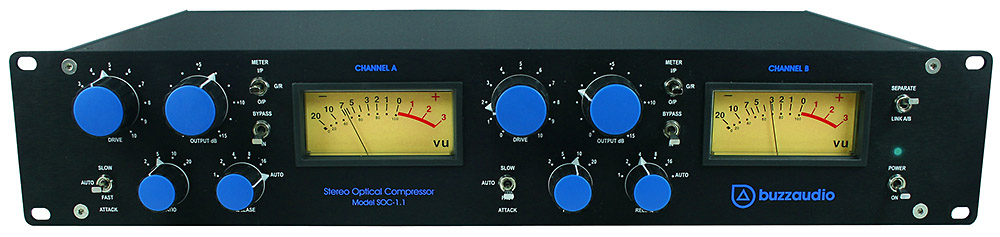
My first visual impressions of the SOC1.1 were promising. Housed in a sturdily constructed matt black 2U rackmount case, the unit has a distinctive ‘old school analogue’ appearance, offering sensible large knobs which are reminiscent of the famous Sifam knobs, but are actually classic knobs from Swiss manufacturer Elma. Two large VU meters dominate the rest of the front panel, along with eight robust metal toggle switches. We’ll examine the various knobs and switches later. The rear panel is simplicity itself, housing four balanced XLR sockets and the power socket.
I got together with John Galbraith, a very experienced engineer and technician in Perth, to check the innards of the SOC1.1 for parts and build quality. We weren’t disappointed. It’s not easy to elicit approving noises from John, but he was certainly nodding and making all the right sounds (yeah… hmm… right!… very good… this is a good unit…) as he showed me around the hand assembled electronics and described how it all works. The first thing we noticed was the neatness – nothing out of place, no extraneous wiring flopping about and plenty of breathing room (for a repair tech to fossick around without breaking anything?). Straight away we noticed the smart use of LED rows in arc formation to light the VU meters, an excellent way to reduce heat and prolong meter life (and which also happens to look great).
A black tube beside each meter contains a simple opto device used in the gain reduction metering circuit which Tim claims gives a more meaningful response. The circuit boards are high quality and the Analog Devices opamps (OP275) are well respected for high-end audio as they run on +20V rails and provide plenty of headroom. Two big, mysterious black cubes contain Buzz Audio’s proprietary optical components, each enclosing an HP Quad LED light block shining onto four Light Dependant resistors. Apparently Tim spent months beavering away on the design, so no wonder it’s all sealed up and well hidden (aside from the need for a darkroom). There are some wire ribbons in the unit, but these aren’t used for program audio, instead providing a path between the output gain control and the feedback of an opamp stage. The power supply is a good quality toroidal. Having satisfied ourselves that the unit is built with loving care, John fired it up, had a smoke, then inserted it between some gnarly music and a car speaker… turned a few knobs and declared it a great compressor! And this is a man who loves good compression and literally knows them all inside out. So off I wandered back to my studio, keen to do some real work with this unit.
Back to the Studio
In the half light of my studio, the only real gripe I have with the SOC1.1 became immediately apparent. The front panel labelling is small (for this 43 year old, anyway) and nigh on impossible to read in a dimly lit room, but it’s worse if you install the unit below eye level. The big knobs are great, but the labels are inscribed beneath the knobs – if the unit is more than slightly below eye level, it needs to be tilted up to read the labels, which isn’t always possible in a rack. That said, there are only a few controls to learn and in wasn’t long before I didn’t need labels at all.
The front panel is a twin configuration with separate controls for each channel. Each channel features a lovely VU meter, a large ‘drive knob, which acts kind of like a threshold control in reverse (i.e clockwise for more compression) and a large output knob which ranges from OdB to + 15dB. The output seems sort of logarithmic, as the first 50% is only 5dB, probably to allow precision settings. This is where the controls would end with a vintage optical compressor, but modern optos usually offer further controls. In the case of the SOC1.1, two smaller detented switch-based knobs control ratio (2,5,10 or 20:1) and release time (1, 2, 4, 8, 16 or Auto). The release times are in 100’s of milliseconds (i.e. 4 = 400ms). An extra touch specially developed by Buzz Audio is a switch which selects between three available attack settings (slow, fast or auto), while another switch toggles true bypass of the SOC1.1 audio electronics (a nice addition). A third switch selects between the three VU meter modes (input, gain reduction or output). Finally, two switches to the right toggle power and stereo linking. Interestingly, when linked, all controls remain operational and the two channels must still be set up individually, even though the side chains are linked. This is actually a nice touch if used carefully, as it gives back control which is usually given up as a result of linking.
Back to the Studio
Within a few minutes of playing my custom Scott Wise acoustic guitar through a vintage Quad 8 mic pre into the SOC1.1 I was desperately trying to figure out how to hide buying it from my other half. No way could I afford it (building a new house and studio has put a complete stop to new toys), but no way was it leaving! All it took was a 2:1 ratio, slow attack and auto release, plus a few dB of compression and the guitar initially sounded exactly how I’d always imagined it could sound. War, round and silky smooth, with a scintillating percussiveness that had me lost in reverie for the next hour or so. I tried all sorts of settings and really had trouble making it sound bad – even serious squashing was palatable –it was ‘wrong’ but it had a nice euphonic character which still made it interesting and listenable.
For a week or so I recorded a variety of vocals, guitar and double bass for a forthcoming release and the SOC1.1 was a constant delight to use. The VU meter ballistics are good (especially in dim light) and configuring the unit is an absolute doddle, although it needs to be said the meters are subject to the usual VU meter averaging. Mostly, it was simply a matter of choosing appropriate settings and dialling in the drive knob until the desired result was achieved. And when your hardware is good, “the search’ is usually short and sweet – almost invariably, I found the ‘right’ setting in less than a minute. Double bass was a revelation, especially when using the classic auto attack setting, which most resembles older optos like the LA-2A. When using this setting, the attack time changes according to the amount of gain reduction in the program, which really seems to suit my whacko double bass technique. By cranking up the pumping, I really felt like I was in Jim Dickinson ‘super compression’ territory (G. Love/Mudhoney turf, for those yet to hear his productions), where even the blats sounded sweet. Similarly, I recorded a weak vocalist and a strong vocalist and had excellent results from both, thanks in no small pat to the auto attack setting. Due to the opto design, the unit has an inherent soft knee characteristic – this suits me perfectly as I generally prefer soft over hard knee in the majority of recordings I work on but it may not cater to everyone’s needs. In this respect, it needs to be said that an optical compressor is not an all purpose workhorse to cover all your dynamics needs. If you can only afford one high-end dynamics processor, you may be better off choosing something more flexible, such as a Distressor.
Acting on a suggestion from Tim, I spent a bit of time with the SOC1.1 inserted over the master stereo bus on a variety of mixes. Mastering engineers usually avoid optical compressors over the L/R bus because of the imprecise nature of the optical components and the slow attack/soft limitations. Optical compressors often have a distinctive ‘sound’ or colouration as a result of fast transients beating the gain reduction. Combined with the variable attack and release characteristics when using ‘auto settings. Additionally, most of the classic optos were mono! However, the SOC1.1 design incorporates a proprietary technique designed to speed up the attack when needed and it certainly seems fast enough for many styles of program audio. Used wisely, I see no significant impediments to the SOC1.1 being used on the L/R bus and found it to be transparent and musical, although the stereo linking requires a good deal of finessing when mastering. The hard bypass is a nice touch (as long as you switch both channels at once!) and I’m looking forward to spending more time working with the unit as a bus compressor, but it really seems more suited to tracking instruments (especially drums, acoustic guitar and bass) and vocals.
Buzz Audio is obviously a company which cares about quality. Here’s hoping the Buzz name achieves more recognition in Australia – on the strength of the SOC1.1 the company’s forthcoming voice channel should be one to watch out for.
Buzz Audio Ltd
Blenheim
New Zealand
Ph +64(0)3-577-5597
send us an email


