


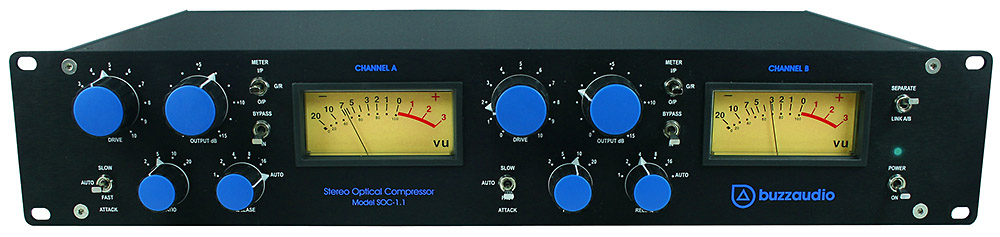

Sometimes the old ways are still the best ways, and many experienced recording engineers may well subscribe to that view when it comes to compression. Optical compressors may seem rather inferior in terms of their tech specs when compared to the current state of the art in VCA and even digital dynamics processors. However, the inherent imperfections of compressors based on optical gain-reduction cells create a certain audio quality which is often extremely beneficial and complementary to music recording in general, and to bass instruments and vocals in particular. The original designs used ordinary incandescent lamps with light-dependent resistors or photosensitive transistors, but these days LEDs are used because they are cheaper and have an infinitely longer life and much faster response - all of the character and none of limitations.
There are many manufacturers with opto-compressors in their portfolio, the newest of which is a New Zealand company, Buzz Audio, which has recently launched a new stereo optical compressor housed in a substantial 2U rackmount case. Its user controls are wonderfully simple and intuitive - harking back to a former era where a couple of big knobs were all that was needed! (Stop sniggering at the back...)
Hardware Tour
The rear panel of this large black box carries XLR sockets for the inputs and outputs of the unit's two channels. This machine can be used as either a dual-channel processor or as a stereo unit, courtesy of a stereo link toggle switch on the front panel. The inputs and outputs are electronically balanced and operate at a nominal +4dBu, although other input sensitivities can be supplied from the factory (including -10dBV). The handbook for the SOC 1.1 helpfully reminds users that the screens of the connecting cables are not required for conveying audio information, and can be disconnected at the sending end to avoid earth loops.
The mains input is via an IEC socket, complete with integral fuse holder, and a separate mains voltage selector is provided on the rear panel. Taking a quick peek inside the box revealed a very tidy construction with unusually high-quality components and ICs - particularly in the I/O circuitry. The gain-reduction element is a light-dependent resistor (LDR) driven by an LED, the pair sealed in a small black module, while the entire circuitry is solid state, with high-quality operational amplifiers used throughout. The electronics are mounted on separate circuit boards for the two channels and their front panel controls, with ICs in sockets and a plethora of sealed trimmers to align the responses of the LDR/LED devices. Ribbon cables interconnect the PCBs, and if servicing became necessary it would appear to be very straightforward to remove and replace components or complete boards. Although it has little bearing on reliability or audio quality, the SOC 1.1 does have something of a hand-built appearance - both internally and externally. While this is most evident in the poor fitting of the self-tapping screws which hold the lid on, the internal quality is better than that found in many mass-produced products, so don't let first impressions put you off.
The published specifications claim a bandwidth extending between 4Hz and 250kHz (-3dB points, and without any gain reduction applied), so this is old-world technology with digital-age performance! Harmonic distortion is below 0.008 percent without gain reduction, rising to 0.03 percent with 20dB of compression. The residual noise is an impressive -100dBu (A-weighted) and crosstalk is below the noise.
The operational controls comprise variable Drive and Output knobs, with switched attack, ratio and release parameters. The huge Drive and Output controls are disturbingly light to the touch - the visual impression suggests psychologically that there should be a certain weight here, so the ease with which these knobs rotate just doesn't seem right! [This has been remedied - Buzz]. The Drive control determines the amount of signal sent to the side-chain and therefore effectively adjusts the threshold above which gain reduction occurs. Turning this knob clockwise produces greater amounts of compression - simple but very intuitive. The Output knob introduces make-up gain from 0 to +15dB, compensating for the inherent reduction in level when compression occurs.
The attack time constant is set by a three-way toggle switch. The centre position is an Auto programme-related setting, with slow and fast options available on either side. The slow setting is around 70ms while the fast is about 1ms - both vary slightly with the amount of gain reduction. The release time is set by a rotary switch with six positions marked 1, 2, 4, 8, 16 and Auto. These numbers represent hundreds of milliseconds - ie. spanning 0.1 to 1.6 seconds - this being the time taken to recover from 20dB of gain reduction. Again, the actual recovery time depends on the amount of gain reduction being applied. The Auto mode employs faster recovery times with transient material, but slower times with more consistent signals in the usual way, and is a safe bet for most material.
The Ratio control is another rotary switch, this time with just four positions: 2, 5, 10 and 20. These define the compression ratio, although, since the unit has a soft-knee characteristic, the declared ratio occurs only after significant gain reduction has been applied - particularly with the lower ratios. Thus much more subtle compression characteristics can be obtained when using moderate amounts of drive, which is exactly what you would want.
There are two final controls - both toggle switches. The lower of the two effects a full bypass through a relay connecting the input directly to the output without any intervening electronics. The second switch selects the signal routed to the large backlit VU meter. The three available options are input signal, gain reduction, and output signal. The backlight is provided by an arc of yellow LEDs mounted on a circuit board fixed behind the meter scale, which is unusual but very effective. The meter is calibrated such that a +4dBu input reads 0VU, as does zero gain reduction. Inevitably, the amount of gain reduction shown by the meter is an approximation, because of the slow averaging characteristic of the meter's ballistics, something which is quite noticeable with fast transient material. The GR meter also continues to show the intended amount of compression even when the channel is bypassed.
The second channel features identical controls to the first, and the right-hand side of the front panel is completed with another pair of toggle switches. The lower one powers the unit and has an associated LED, while the top one engages the stereo linking facility. Although this links the side-chains of both channels in some way, it is essential that all controls are set to identical positions, which can be tedious.
In the Studio
The SOC 1.1 reminds me how much I like optical compressors! It is so easy to use: set the ratio for the required amount of 'squash', then crank up the Drive control until the desired sound is achieved. The Output control will restore the level and the Attack and Release controls can be adjusted to taste and to minimise any pumping effects. Largely as expected, I found the device to be fabulous on bass instruments (provided the Release control wasn't set too fast) and extremely good with vocals. It seemed equally effective whether delivering gentle, subtle compression or full-on total squashing of the dynamics. In all cases, it sounded musical - if not always transparent - and I was always able to find a setting which worked, regardless of the nature of the source or material. What more could you ask of a compressor?
Using the unit to compress a stereo master was successful, but more fiddly than I would have liked, mainly because of the requirement to set both channels identically. However, this is a minor complaint and the results easily compensate for the small amount of operational fiddling. This is a charming compressor in every way. It sounds sublime, it is a no-brainer to use, and it delivers results which are nothing if not musical.
[2002]
Buzz Audio Ltd
Blenheim
New Zealand
Ph +64(0)3-577-5597
send us an email


