


 | US$900 | €795 | £695 |

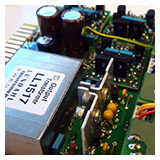
As with the other 500 Series modules in this range, the Tonic signal path uses our True Class A BE41 amplifiers followed by a BE50 buffer to excite the Lundahl output transformer. The resulting sound is big and open with a nice touch of transformer color. The design allows for +26dB headroom so major boosts at low frequencies are not a problem with the Tonic - it always sounds huge!
The Tonic utilizes real inductors (chokes) in the high and low bands whilst the sweepable mid band features an active filter based on the Constant Amplitude Phase Shift circuit proposed my Mr Steve Dove in 1981. The combination of the old passive circuits with a modern active design gives you the best of both worlds. The chokes in the bass and treble provide the smooth sound of real resonance in addition to the versatility of the sweep mid band.

 Other 500 series modules - | Essence opto compressor | Elixir mic preamp |
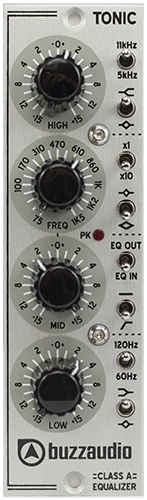
 The low band and high band have centre detent pots for +/-15dB of boost/cut range. Toggle switches select bell or shelf mode on these two bands. The low band turnover frequency can be selected to 60Hz or 120Hz and the high band 5kHz or 11kHz.
The mid band frequency can cover the range of 75Hz to 11.5kHz via the x1/x10 range switch. Another switch selects wide or narrow bandwidth (Q), and a centre detent pot sets the mid band +/-15db boost/cut range.
Additional toggles are provided to Bypass the module and to switch in the High Pass Filter. The high pass filter turnover frequency can be set by the user to 85Hz or 50Hz via jumpers on the circuit board. A Peak led lights up when the output level reaches +22dBu.
 Hey, just wanted to mention to you that I've been using your Tonic pretty extensively lately. Incredibly useful design and it sounds phenomenal! It has already made many appearances on the drum samples I've been making for my next release. Just the ticket for electric guitar too. Very nice work. I have to check out more of your stuff!
Supersonic Samples
Maximum Input Level; +23dBu
Maximum Output Level; +26dBu into 3k ohm load
Frequency Response EQ set flat; 17Hz to 175kHz (+1dB, -3dB)
Harmonic Distortion measured +10dBu output level; 0.08% @ 100Hz, 0.02% @ 1kHz, 0.005% @ 10kHz
Signal to Noise Ratio; -88dB A wtg, input shorted
Input Impedance; 20k ohms approx balanced
Indicators; Single LED overload indicator
Size; (37Wx132H). Fits 1 space in API* 500 series rack format
Power requirements; 120mA +/- 15-18 volts DC, as supplied by frame power supply.
Specifications are typical of a production unit and are subject to change without notice. 0dBu reference = 0.775 volts RMS

The BE41 is a unique Class A discrete audio amplifier designed by Tim Farrant, the owner of Buzz Audio here in New Zealand. The circuit was originally intended for amplifying the very low level output of moving coil pickup cartridges so it features a very low self noise. It exhibits a wide frequency response and very fast slew rate - even at high gains. The powerful output stage has a self adjusting bias arrangement for excellent reliability.
There are two versions of the BE41, one optimized for low level signals (such as microphone inputs) and the other for higher line level signals. The BE41 runs on up to +/-20V power rails, whilst the bigger brother BE40 runs on up to +/-28V rails.
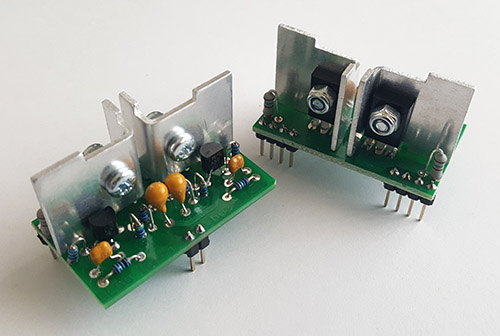
The BE50 is a unique Class A audio buffer designed by Buzz Audio owner Tim Farrant. This unit is designed to boost the output of an audio amplifier and provides very high drive current capability. We use the BE50 module to drive output transformers in our 500 Series products where the available power rail is only +/-15 volts.
Buzz Audio Ltd
Blenheim
New Zealand
Ph +64(0)3-577-5597
send us an email


