



Making quiet references to vintage design, this Kiwi compressor out performs many modern units with louder claims to 'classic' valve status. George Shilling favours photons over electrons.
This unit hails from a company in New Zealand which apparently has many strings to its bow, including PA installation, studio design, sound systems for public areas, and custom-build electronics. The SOC 1.1 is a stereo optical compressor for pro-audio, and a couple of these have already found their way to a London postproduction house. The SOC 1.1 uses an in-house designed gain reduction element, comprising four selected miniature Light Dependant Resistors driven by a 4x led light block. They claim that by using four LDRs they can even out the wide tolerances of the devices and get a predictable result. The led light block is driven differentially, similar to an output stage in a power amplifier, where one half of the block handles positive waveform and the other negative waveform.
Construction is fairly conventional, with a sturdy 2U-high housing, which feels rigid. Inside the unit is a collection of small circuit boards hosting discrete components, connected by ribbon cables and flying leads. The whole package has something of the appearance and character of a unit made about 20 years ago--which is not necessarily a bad thing. The back panel is very simple, with inputs and outputs on XLR connectors only.
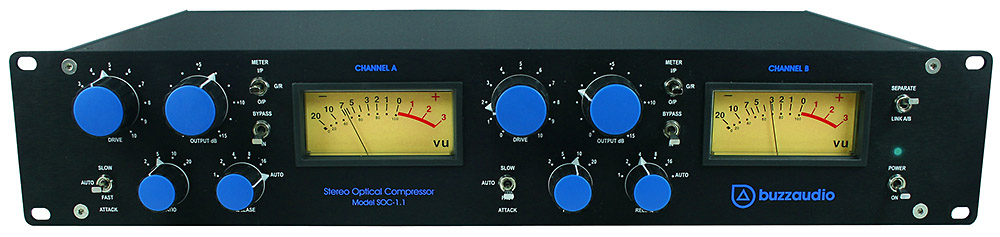
The front panel layout is excellent, dominated by each channel's vu meter. These are unconventionally backlit with an arced row of yellow leds behind the scale markings. A 3-position toggle switch accompanies each meter, allowing display of input and output levels, along with conventional gain reduction indication. Each channel includes a huge drive knob which sends more signal to the sidechain circuit. This circuit processes the audio to drive the light block. A similarly large output knob features alongside, which in reality is a make-up gain control with a range of 0 to +15dB, although halfway round is only a 5dB boost, enabling precision setting of final levels in most instances. Both of these controls have a loose feel, (they are the same type used by Manley), but this was not a problem, as their size makes adjustment easier, and the knob pointers are clearly marked. Unfortunately, this is not true of the panel legending--fairly small and quite dark blue lettering on a black background is not ideal for the lighting situations in most studios. Even in a fairly bright room I found it hard to read the settings and labels. [The SOC now has white panel lettering and we now use different pots with a tighter feel]
Ratio is controlled separately for each channel with a 4-position rotary switch with a positive feel. Settings are 2:1, 5:1, 10:1 and 20:1, although these reflect ultimate ratio after crossing a fairly soft knee that covers a range of about 10dBs, or 5dBs in the 20:1 setting. Attack is set using a toggle switch with three positions: Slow, Auto and Fast. All three settings are useable, with the programme-dependent Auto setting sounding most natural and musical in many situations. Slow is approximately 70ms and is great for adding punch to percussive sounds, while Fast is around 1ms and most suitable for heavy compression settings. Release is controlled by a rotary switch with six positions. This is labelled 1, 2, 4, 8, 16 and Auto. The numbered settings approximate to release time in 100s of ms. The Auto setting is programme dependent, releasing quickly from fast transients, and taking longer after a period of continuous gain reduction. With the optical circuit, all settings are somewhat programme dependent, and this makes for an excellent sounding characteristic.
I generally used the unit in Auto mode for attack and release, which seemed to sound the most natural. The overall sound of the unit is large, full and open, and it is not difficult to find a setting that pleases the ear on all kinds of individual sounds as well as on programme. Each channel includes a hard-wire bypass toggle switch, and the unit automatically goes into Bypass mode if power fails. A power switch is accompanied by a small led, which is the only indicator light on the front panel. There is also a toggle switch to enable stereo linking of the two channels. This links the compressor sidechains, but all controls remain active. It is therefore important to set both channels' controls similarly for proper stereo operation.
Overall this unit is terrific; whether pumping or transparently controlling, it out-performs many over-hyped valve designs, and has a good range of settings for different uses and tastes. It always sounds large and full, and performance is excellent in terms of frequency response, noise and distortion. The large drive and gain knobs are great for making fine tweaks. The manual is clear and helpful, and apart from the poor panel legending, the whole design and construction is excellent: there is no nonsense or hype.
The NZ dollar price quoted to me sounds very reasonable, and I heartily recommend auditioning one of these alongside more familiar designs and names.
[July 2001]
Buzz Audio Ltd
Blenheim
New Zealand
Ph +64(0)3-577-5597
send us an email


